So here's the thing about Void of Course Moon: everyone talks about it, most apps claim to track it, and almost nobody calculates it the same way.
If you're building an astrology app - or just trying to understand what VOC actually means - this is the guide I wish I had when I started.
TL;DR
Moon is "void of course" when it makes no major aspects before changing signs. It's critical for timing apps, horary questions, and horoscopes. The tricky part? Calculation varies wildly depending on which tradition you follow - and most apps get it wrong.
What is Void of Course Moon?
Duration can be anywhere from 2 minutes to over 2 days. It happens roughly 12+ times per month.
A Brief History (Because the Definition Changed)
Original definition from Porphyry: Moon is void when NOT applying to any Ptolemaic aspect within the next 30 degrees - regardless of sign boundaries. This was rare. Maybe a few times per year.
Al Morrison popularized VOC for mainstream astrology, producing annual calendars and expanding its use beyond horary into natal and mundane astrology. This is largely why we talk about it so much today.
Key insight: the "traditional" VOC that apps claim to use isn't actually that traditional - it's been redefined multiple times.
Where VOC Is Actually Used
| Application | How VOC Matters |
|---|---|
| Horary Astrology | Radicality check - VOC often means "nothing will come of the matter" |
| Electional Astrology | Avoid starting important events during VOC |
| Daily Horoscopes | Timing warnings for users |
| Tarot Readings | Some readers avoid VOC for important spreads |
The Calculation Problem
This is where it gets interesting for developers.
It's Not Simple
Why VOC calculation is trickier than it looks:
Different traditions use different aspect sets:
- Traditional (5 Ptolemaic): conjunction 0°, sextile 60°, square 90°, trine 120°, opposition 180°
- Extended (7 aspects): adds semisextile 30°, quincunx 150°
- Professional (8 aspects): adds septile 51.43°
- Comprehensive (9 aspects): adds sesquiquadrate 135°
Same Moon, same moment - completely different VOC status depending on which set you use.
- Classical: Sun through Saturn (7 planets)
- Modern: adds Uranus, Neptune, Pluto (10 planets)
If Moon is about to trine Neptune but you're only checking classical planets - your app says "void" when a modern astrologer would say "not void."
You need to:
- Calculate exact aspect perfection times (not approximate)
- Find precise sign ingress time
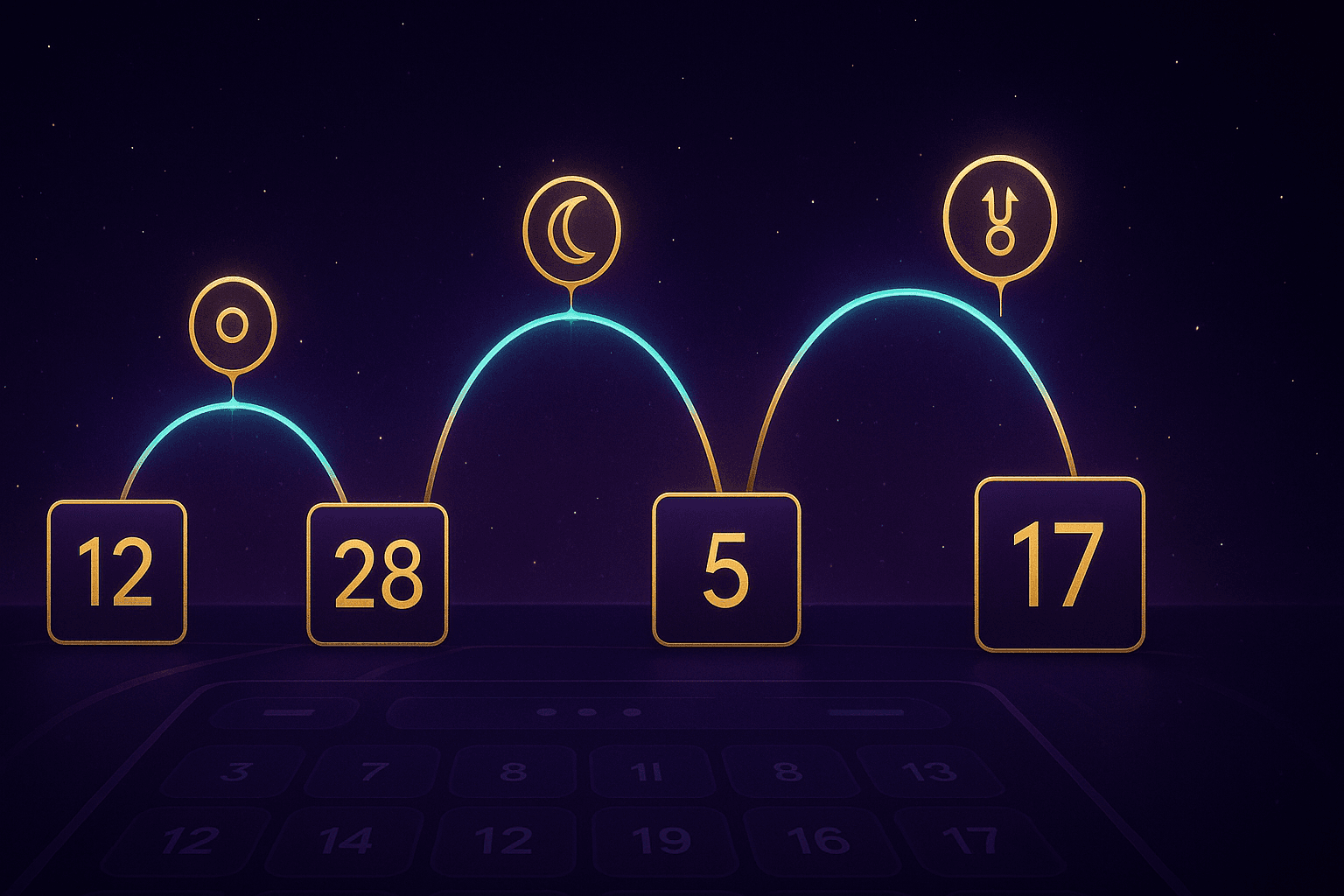
- Compare: if last perfecting aspect happens before ingress, the gap between them is VOC
The Formula (Simplified)
1VOC_start = time of Moon's last perfecting aspect2VOC_end = time of Moon's next sign ingress3is_void = (current_time > VOC_start) AND (current_time < VOC_end)Why Most Apps Get It Wrong
I've seen apps that:
- Use only 5 aspects when their users expect 7 or 9
- Don't distinguish applying from separating aspects
- Ignore orb calculations entirely
- Have timezone bugs that shift VOC periods by hours
- Cache calculations without accounting for location
If your users are astrology-savvy, they'll notice.
Vedic Parallel: Kemadruma Yoga
Interesting side note: Vedic astrology has a similar concept called Kemadruma Yoga, though the calculation is completely different.
Kemadruma forms when:
- No planet in 2nd house from Moon
- No planet in 12th house from Moon
- Moon not aspected by any planet except Sun
It's about lunar isolation too, but through placement rather than aspects. Different tradition, same underlying observation: sometimes the Moon is "alone" - and that matters.
What to Avoid During VOC
The traditional advice (take with appropriate skepticism):
- Signing contracts
- Launching businesses or projects
- Job interviews
- First dates or proposals
- Major purchases
- Surgery (if you can schedule it)
- Routine tasks
- Completing existing work
- Meditation, rest
- Creative exploration (non-public)
The caveat: VOC happens 12+ times per month. If everything started during VOC truly failed, our civilization would collapse. Use it as a caution flag, not an absolute prohibition.
FAQ
Roughly 12-15 times per month, depending on which aspect system you use. More aspects = fewer VOC periods.
Anywhere from a few minutes to over 2 days. Average is probably 8-12 hours.
Depends on your tradition. Traditional horary uses 5 Ptolemaic aspects. Modern practitioners often use 7 or 9. There's no universal standard - which is why configurable systems matter.
Debated. Traditional astrology didn't use VOC for natal interpretation - it was a horary/electional tool. Modern astrologers sometimes consider it, but it's not universally accepted.
No. Kemadruma Yoga is conceptually similar but calculated differently (planet placement vs. aspects). They're parallel concepts, not the same thing.
Yes, but it requires ephemeris data, aspect calculations, and handling multiple edge cases. Most developers find it's not worth building from scratch.
Building an App?
If you need VOC timing in your application, here's what to look for:
- Configurable aspect systems (users have preferences)
- Swiss Ephemeris precision (±1 minute accuracy)
- Timezone-aware calculations (VOC times are location-dependent)
- Both current status and upcoming periods (users want to plan ahead)