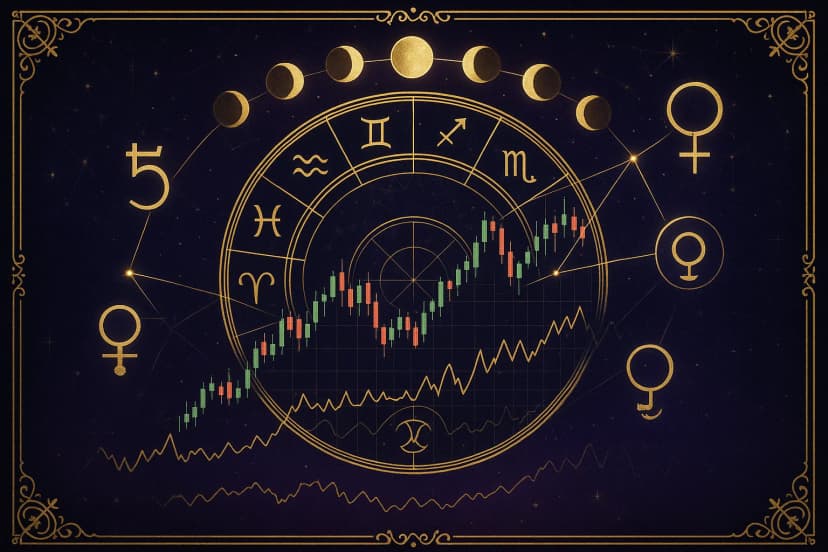
J.P. Morgan allegedly said "Millionaires don't use astrology, billionaires do."
Whether he actually said it is debatable. But here's what's NOT debatable: some traders are using planetary cycles as alternative data. And you can build your own tracking system.
TL;DR for Developers
- Astrology trading = using planetary cycle data as alternative market indicators
- Key events: lunar phases, Mercury retrograde, major planetary aspects
- Astrology API provides 6 dedicated financial endpoints for market timing
- Bradley Siderograph, Gann analysis, crypto timing all available via API
- Treat as ONE factor among many, not standalone strategy
- Always include disclaimers, statistical rigor, and proper risk management
- Peak seasonality: December-January (1.5-2x search interest)
What is Astrology Trading? No Mysticism, Just Data
Let's strip away the mystical language and look at this from a data science perspective.
- Tracking measurable astronomical events (planetary positions, aspects, phases)
- Correlating with historical market data
- Testing for statistical significance
- Building indicators (not predictions)
This is alternative data analysis, not fortune-telling.
Planetary positions are predictable astronomical data. Market behavior is partly driven by human psychology. The hypothesis: collective human behavior may correlate with cosmic cycles. Similar to how seasonal patterns and lunar effects on sleep and mood are scientifically documented.
We're not predicting the future. We're testing whether predictable astronomical events correlate with measurable market patterns.
Historical Context
Astrology API provides dedicated endpoints for financial astrology:
- Bradley Siderograph calculations
- Gann cycle analysis
- Personal trading windows
- Crypto and forex-specific timing
Key Planetary Cycles Traders Track
Lunar Phases
The most researched cycle in financial astrology.
| Phase | Cycle Length | Trading Hypothesis |
|---|---|---|
| New Moon to Full Moon | 14.75 days | Accumulation phase, building positions |
| Full Moon | Peak | High volatility, potential distribution |
| Full Moon to New Moon | 14.75 days | Distribution phase, reducing positions |
Several academic papers show statistically significant patterns around lunar phases. Dichev and Janes (2003) found stock returns are higher around new moons than full moons.
Mercury Retrograde
Occurs 3-4 times per year, lasting approximately 3 weeks each time.
12026 Mercury Retrograde Periods:2- March 14 to April 73- July 17 to August 104- November 9 to November 29Saturn-Jupiter Cycle (Great Conjunction)
| Metric | Value |
|---|---|
| Cycle Length | Approximately 20 years |
| Last Occurrence | December 2020 |
| Next Occurrence | Approximately 2040 |
| Historical Observation | Often coincides with major market shifts |
The 2020 conjunction at 0 degrees Aquarius coincided with the start of a major market cycle.
Planetary Ingress Events
When planets change zodiac signs, it creates natural "chapters" in longer cycles. These are trackable, predictable, and programmable events.
The Gann Method: Astrology for Traders Explained
W.D. Gann (1878-1955) was a legendary trader who documented 85%+ win rate claims. He heavily used time cycles and planetary angles. His methods remain controversial but influential.
Key Gann Astrological Concepts
- 90-degree (square) aspects as resistance and support levels
- 120-degree (trine) as harmonious flow periods
- 180-degree (opposition) as reversal points
- Saturn cycle: 29.5 years
- Jupiter cycle: 12 years
- Mars cycle: 2 years
Gann Analysis via API
1// Gann Analysis with Astrology-API.io2const getGannCycles = async (priceLevel, date) => {3    const response = await fetch(4        'https://api.astrology-api.io/api/v3/insights/financial/gann-analysis',5        {6            method: 'POST',7            headers: {8                'Authorization': `Bearer ${API_KEY}`,9                'Content-Type': 'application/json'10            },11            body: JSON.stringify({12                date: date,13                price_level: priceLevel,14                cycles: ['saturn', 'jupiter', 'mars']15            })16        }17    );18
19    return await response.json();20};
Bradley Siderograph: The Classic Market Timing Tool
How It Works
Bradley assigned numerical values to different planetary aspects:
- Positive values for "harmonious" aspects (trines, sextiles)
- Negative values for "challenging" aspects (squares, oppositions)
The resulting line shows peaks and valleys that some traders interpret as potential market turning points.
Using Bradley Turns via API
1// Get Bradley Siderograph turning points2const getBradleyTurns = async (year) => {3    const response = await fetch(4        'https://api.astrology-api.io/api/v3/insights/financial/bradley-siderograph',5        {6            method: 'POST',7            headers: {8                'Authorization': `Bearer ${API_KEY}`,9                'Content-Type': 'application/json'10            },11            body: JSON.stringify({12                year: year,13                include_graph_data: true,14                turning_point_threshold: 'major'15            })16        }17    );18
19    const data = await response.json();20
21    return {22        turningPoints: data.turning_points,23        graphData: data.daily_values,24        majorDates: data.major_reversals25    };26};27
28// Example usage29const bradley2026 = await getBradleyTurns(2026);30console.log('Major turning points:', bradley2026.majorDates);
Crypto-Specific Timing
Cryptocurrency markets have unique considerations for astrological analysis.
Why Crypto is Different
| Factor | Traditional Markets | Crypto Markets |
|---|---|---|
| Trading Hours | Set sessions | 24/7 |
| Participant Psychology | Institutional heavy | Retail heavy |
| Historical Data | 100+ years | Under 15 years |
| Birth Chart | Various inception dates | Bitcoin: Jan 3, 2009 |
Bitcoin's "birth chart" is January 3, 2009 at 18:15 UTC, when the genesis block was mined. Some traders track transits to this chart.
Crypto Timing Endpoint
1// Crypto-specific timing analysis2const getCryptoTiming = async (coin) => {3    const response = await fetch(4        'https://api.astrology-api.io/api/v3/insights/financial/crypto-timing',5        {6            method: 'POST',7            headers: {8                'Authorization': `Bearer ${API_KEY}`,9                'Content-Type': 'application/json'10            },11            body: JSON.stringify({12                date: new Date().toISOString(),13                coin: coin,14                include_bitcoin_aspects: true,15                include_lunar: true,16                forecast_days: 717            })18        }19    );20
21    const data = await response.json();22
23    return {24        currentPhase: data.market_phase,25        volatilityForecast: data.volatility_score,26        keyDates: data.significant_dates,27        bitcoinAspects: data.bitcoin_natal_aspects28    };29};
Key Events Crypto Traders Track
- Bitcoin's transits (planets aspecting its natal chart)
- Mercury retrograde (exchange issues, wallet problems)
- Uranus aspects (sudden moves, technology changes)
- New Moons (accumulation periods)
- Full Moons (potential tops, high volume)
Building Your Astrology Trading Tracker
Think of this like building a weather station, but for planetary events. You're not predicting the future - you're creating a system that tracks cosmic conditions and correlates them with market behavior over time.
Here's the architecture:
1Astrology API (Data) → Your Backend (Analysis) → Dashboard (Visualization)The key insight: planetary positions are 100% predictable. We know exactly where Saturn will be in 2030. The question is whether these predictable events correlate with less-predictable market behavior.
Step 1: Set Up Planetary Data Feed
| Endpoint | What You Get |
|---|---|
/insights/financial/market-timing | Current planetary conditions affecting markets |
/insights/financial/gann-analysis | Price-to-degree correlations for Gann traders |
/insights/financial/bradley-siderograph | Calculated turning point dates |
/insights/financial/crypto-timing | Bitcoin natal chart aspects |
1const timing = await fetch('https://api.astrology-api.io/api/v3/insights/financial/market-timing', {2 method: 'POST',3 headers: { 'Authorization': `Bearer ${API_KEY}` },4 body: JSON.stringify({ date: new Date().toISOString(), market: 'stocks' })5});Step 2: Create Event Detection System
POST /api/v3/insights/financial/market-timing — returns current lunar phase, active aspects, retrograde status, and upcoming events in one call.- Mercury retrograde start/end dates (3-4x per year)
- New and Full Moons (monthly)
- Major planetary aspects (varies)
- Planetary sign changes (ingresses)
- Void-of-course Moon periods (multiple times weekly)
The goal is automation. You shouldn't manually check ephemeris tables - your system should alert you when significant events approach.
Step 3: Build a Correlation Engine
- Collect historical planetary event data (past 10-20 years)
- Collect corresponding market price data
- Measure what happened around each event type
- Calculate statistical significance
POST /api/v3/insights/financial/bradley-siderograph — includes historical graph data for backtesting Bradley turn accuracy. For other events, query market-timing with historical dates.For example: "What was the average S&P 500 return in the 5 days following each New Moon since 2010?" If you find +0.15% average with p-value < 0.05, you might have something. If p-value > 0.10, it's likely noise.
- Average return around event (is there a pattern?)
- Standard deviation (how consistent is it?)
- Sample size (enough data to matter?)
- P-value (statistically significant or random?)
This is the scientific backbone of your system. Skip this step, and you're just practicing astrology, not building a trading edge.
Step 4: Personal Trading Windows (Optional)
POST /api/v3/insights/financial/personal-trading — send birth data, get favorable/challenging periods and active transits affecting your trading decisions.This is the most speculative step. If you're skeptical, skip it. If you're curious, track your trading performance during different transit periods and see if patterns emerge over 6-12 months.
Step 5: Alert System
POST /api/v3/insights/financial/market-timing daily — check upcoming events and trigger alerts based on your thresholds. For crypto, use /crypto-timing; for forex, use /forex-timing.- "Mercury retrograde starts in 3 days - consider closing volatile positions"
- "Full Moon tomorrow - expect higher volume"
- "Mars-Uranus square exact today - heightened volatility possible"
The key is not to over-alert. Pick 3-5 event types that your backtesting shows actually matter, and ignore the rest.
Backtesting Planetary Patterns
Before using any astrological signal, you need to backtest it rigorously.
1# Backtesting lunar phase impact2import astroapi3import yfinance as yf4from datetime import timedelta5
6def backtest_lunar_phases(ticker, start_year, end_year):7    """8    Test hypothesis: Market behavior differs9    around New Moon vs Full Moon10    """11    results = {12        'new_moon': [],13        'full_moon': []14    }15
16    # Get historical price data17    prices = yf.download(ticker,18                         start=f'{start_year}-01-01',19                         end=f'{end_year}-12-31')20
21    # Get all lunar phases in date range22    for year in range(start_year, end_year + 1):23        phases = astroapi.get_lunar_phases(year)24
25        for phase in phases:26            date = phase['date']27            phase_type = phase['type']28
29            try:30                start_price = prices.loc[date, 'Close']31                end_date = date + timedelta(days=5)32                end_price = prices.loc[end_date, 'Close']33
34                return_pct = (end_price - start_price) / start_price35                results[f'{phase_type}_moon'].append(return_pct)36            except:37                continue38
39    # Statistical analysis40    new_moon_avg = np.mean(results['new_moon'])41    full_moon_avg = np.mean(results['full_moon'])42
43    t_stat, p_value = stats.ttest_ind(44        results['new_moon'],45        results['full_moon']46    )47
48    return {49        'new_moon_avg_return': new_moon_avg,50        'full_moon_avg_return': full_moon_avg,51        'difference': new_moon_avg - full_moon_avg,52        'p_value': p_value,53        'statistically_significant': p_value < 0.0554    }
Sample Backtest Results Format
| Event Type | Avg 5-Day Return | Sample Size | P-Value | Significant |
|---|---|---|---|---|
| New Moon | +0.18% | 248 | 0.032 | Yes |
| Full Moon | -0.05% | 248 | 0.089 | No |
| Mercury Rx Start | -0.42% | 62 | 0.045 | Yes |
| Jupiter-Saturn Conj | +2.1% | 4 | N/A | Insufficient data |
Forex and Intraday Applications
Intraday Considerations
For day trading with astrology, traders look at:
- Lunar hour calculations
- Planetary hour systems
- Void-of-course Moon periods
- Real-time aspect formation
Forex-Specific Implementation
1// Forex timing with dedicated Astrology API endpoint2const getForexTiming = async (currencyPair) => {3    const response = await fetch(4        'https://api.astrology-api.io/api/v3/insights/financial/forex-timing',5        {6            method: 'POST',7            headers: {8                'Authorization': `Bearer ${API_KEY}`,9                'Content-Type': 'application/json'10            },11            body: JSON.stringify({12                date: new Date().toISOString(),13                pair: currencyPair,14                include_lunar: true,15                include_planetary_hours: true,16                include_void_moon: true17            })18        }19    );20
21    const data = await response.json();22
23    return {24        moonSign: data.moon_sign,25        isVoidMoon: data.void_of_course,26        currentPlanetaryHour: data.planetary_hour,27        activeAspects: data.active_aspects,28        volatilityScore: data.volatility_score,29        tradingWindows: data.optimal_windows30    };31};
Common Mistakes and How to Avoid Them
Mistake 1: Treating Correlations as Causation
Correlation does not imply causation. Always use precise language.
Mistake 2: Cherry-Picking Data
- Always use complete datasets
- Include failures, not just successes
- Report statistical significance with p-values
- Use out-of-sample testing
Mistake 3: Over-Optimization
- Don't curve-fit to historical data
- Use walk-forward analysis
- Simple models often outperform complex ones
- Beware of data mining bias
Mistake 4: Ignoring Transaction Costs
- Factor in slippage, fees, and spreads
- Many "profitable" patterns disappear after costs
- Test with realistic execution assumptions
Mistake 5: Confirmation Bias
- Track ALL trades, not just winners
- Use blind testing where possible
- Get peer review on methodology
- Document before, not after
The biggest mistake in astrology trading is seeing patterns that aren't there. Statistical rigor is non-negotiable.
Integration with Trading Platforms
TradingView Custom Indicator
1// TradingView Pine Script - Lunar Phase Indicator2//@version=53indicator("Lunar Phase Overlay", overlay=true)4
5// These values would come from your backend6// that fetches from Astrology API7newMoonDates = input.string("2026-01-18,2026-02-17,...")8fullMoonDates = input.string("2026-01-03,2026-02-01,...")9
10// Plot markers on chart11// Implementation would parse dates and show markers
Python Trading Bot Integration
1# Adding astro signals to a trading bot2class AstroEnhancedBot:3    def __init__(self, exchange, astro_client):4        self.exchange = exchange5        self.astro = astro_client6
7    async def should_trade(self, signal):8        """9        Add astro overlay to existing trading signals10        NOT replacing your strategy, just adding context11        """12        conditions = await self.astro.getCurrentConditions()13
14        # Reduce position size during Mercury Rx15        if conditions['mercury_retrograde']:16            signal['position_size'] *= 0.517            signal['notes'] = 'Mercury Rx: Reduced size'18
19        # Avoid new positions during Void Moon20        if conditions['moon_void']:21            if signal['type'] == 'entry':22                return None23
24        return signal
Frequently Asked Questions
General Questions
Astrology trading uses planetary cycle data as an alternative market indicator. It tracks predictable astronomical events (lunar phases, planetary positions, aspects) and correlates them with historical market behavior. It's pattern recognition using cosmic cycles as one data input among many, not prediction or fortune-telling.
There's no guaranteed profitability. Some academic studies show statistically significant correlations, particularly with lunar phases. However, results vary widely. Treat astrological signals as one factor among many, never as a standalone strategy. Risk management remains essential regardless of methodology.
Some do. W.D. Gann documented his use of planetary cycles. Bloomberg terminals include horoscopes. Several hedge funds explore alternative data including cosmic cycles. It's more common than publicly discussed, though most prefer to keep their edge private.
Financial astrology focuses on mundane (world) events rather than personal charts. It tracks planetary cycles affecting collective behavior, market psychology, and global trends. The emphasis is on quantifiable correlations rather than personal readings.
Technical Questions
Created in 1948 by Donald Bradley, it's a formula combining planetary aspects into a single line that indicates potential market turning points. Still published today, though accuracy is debated. Available through Astrology API's bradley-siderograph endpoint.
Use astronomical ephemeris data available via APIs like Astrology API. Planetary positions are measured in degrees of zodiacal longitude. Aspects are specific angular relationships: conjunction (0 degrees), sextile (60), square (90), trine (120), opposition (180).
Start with: New and Full Moons, Mercury retrograde periods, major outer planet aspects (Jupiter-Saturn, Saturn-Uranus), and planetary ingresses (sign changes). Begin simple, add complexity as you understand patterns.
Some traders use intraday techniques like planetary hours and void-of-course Moon periods. However, shorter timeframes show weaker correlations in backtesting. Day trading with astrology requires extensive validation and realistic expectations.
Combine historical ephemeris data with price data. Test specific hypotheses with clear criteria. Calculate statistical significance using t-tests or similar methods. Use out-of-sample testing. Always account for transaction costs.
Gann-Specific Questions
Gann integrated planetary angles and cycles into his trading methodology. He converted prices to degrees, found aspects to planetary positions, and used time cycles based on planetary orbits. His exact methods remain partly mysterious, documented across his various courses and books.
Gann tracked Saturn's 29.5-year cycle, Jupiter's 12-year cycle, and Mars's 2-year cycle for timing. He looked for planetary aspects at major price levels. His "Square of 9" calculator incorporates degrees that can correspond to planetary positions.
Practical Questions
Use an API like Astrology API to fetch planetary positions, aspects, and events programmatically. Integrate with your existing system via REST endpoints. Start with simple indicators (lunar phase, Mercury retrograde) before adding complexity.
Yes. Astrology API provides comprehensive planetary data including six dedicated financial endpoints: market-timing, personal-trading, gann-analysis, bradley-siderograph, crypto-timing, and forex-timing. All return structured JSON data suitable for trading system integration.
Main risks include: over-reliance on one signal, confirmation bias, curve-fitting to historical data, and ignoring fundamental analysis. Always use proper risk management. Treat astrological signals as supplementary context, never as primary decision criteria.
"Accuracy" is the wrong frame. Astrology trading is about probability and edge, not prediction. Some patterns show statistical significance in backtesting. However, no method guarantees future results. Focus on risk-adjusted returns and proper position sizing rather than seeking predictions.
No. Astrological analysis should supplement, not replace, traditional analysis. Use it as one factor in a multi-factor approach. Combine with technical analysis, fundamental analysis, and proper risk management. Never bet your portfolio on any single methodology.
Resources and Further Reading
Academic Research
- Dichev, I. and Janes, T. (2003) - "Lunar Cycle Effects in Stock Returns" - Journal of Private Equity
- Yuan, K., Zheng, L. and Zhu, Q. (2006) - "Are Investors Moonstruck?" - Review of Financial Studies
- Various correlation studies examining lunar effects on financial markets
Historical Works
- W.D. Gann's original courses and writings on time cycles
- Donald Bradley's Siderograph methodology documentation
- "The Astrology of the Macrocosm" - financial astrology anthology
Modern Tools
- Astrology API financial endpoints for programmatic access
- TradingView for chart integration
- Python and JavaScript libraries for backtesting
Conclusion: A Balanced Approach
Astrology trading is not about predicting the future. It's about:
- Tracking measurable astronomical data as one alternative signal
- Testing correlations with statistical rigor
- Adding context to existing trading strategies
- Maintaining skepticism while remaining open to patterns
The planets don't control markets. But collective human behavior might correlate with cosmic cycles in ways worth investigating.
Build your system. Test your hypotheses. Document your results. And always remember: no methodology guarantees profits.
Ready to build your own planetary analysis system? Astrology API provides all six financial endpoints discussed in this article, with real-time data and historical backtesting capabilities.