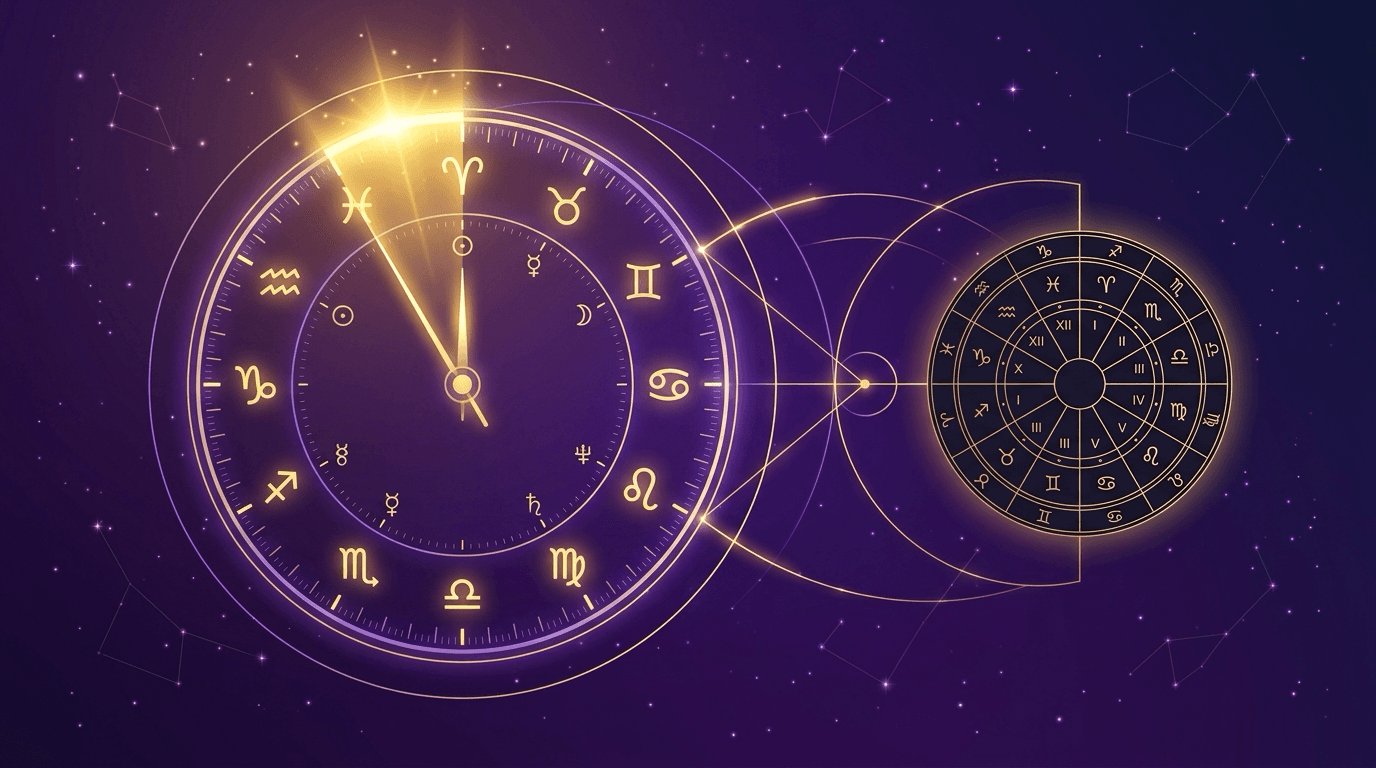
The churn problem nobody priced in
Most astrology apps are built around one feature: the daily horoscope. It is the easiest thing to ship, the easiest thing to demo, and the easiest thing for a user to walk away from.
Here is the trap. Daily content drives installs and early opens, but it has almost no switching cost. A user who reads "today is a good day for communication" on your app gets the exact same line, give or take a verb, from six other apps and a free widget. Nothing in that experience ties them to you. When the novelty fades, they uninstall, and they do not notice the loss because tomorrow's horoscope is everywhere.
The numbers behind this are brutal and well known. Lifestyle and astrology apps routinely lose the large majority of new installs inside the first week, and a thin slice survives to day 30. You can pour money into the top of the funnel and watch most of it leak out the bottom, because the product gives no one a concrete reason to still be there next month.
This post is about why long-horizon content retains where daily content churns, what you can charge for it, and why building it yourself is weeks of ephemeris work you do not need to do.
Why a long horizon retains
Daily content fails at retention for a structural reason: a person cannot feel a real shift in their life every 24 hours. The daily read becomes background noise, and background noise is easy to mute.
A multi-year roadmap works the opposite way. It hands the user a small set of genuinely consequential dates and tells them what those dates mean. A Saturn return window in the spring of 2028. A Jupiter-return year. The month a slow outer-planet transit finally exits a tense aspect to their natal Sun. These are not "good day for communication" filler. They are the few moments in a multi-year stretch that people actually anticipate, and once a user knows one is coming, they have a reason to return at a known future date to see what it brings.
That changes the shape of engagement. Instead of trying to manufacture a daily reason to open the app, you have planted a handful of fixed future appointments in the user's head, each one tied to their own chart. The roadmap re-anchors at every birthday too, because a new year of the forecast comes into focus and the profection year rolls over. You are not scheduling these returns. The sky scheduled them years ago. The report just tells the user where they are.
The Multi-Year Transit Roadmap is dense with these hooks on purpose. It breaks the next several years into life chapters, each defined by an outer-planet ingress, so the user sees their future as named stretches rather than an undifferentiated blur. It lays out full transit activation windows to their natal points: when a transit starts, the exact station dates where it stalls and bites hardest, and when it clears. It overlays annual profection briefings and a Firdaria time-lord period so each year has a clear theme. A monthly intensity calendar shows which months run hot and which run quiet. Convergence detection flags the rare windows where several heavy transits stack at once, which are the months a user most wants warning about.
Every one of those is a future date with meaning attached. That is the raw material of a retention loop that daily content cannot produce.
The retention math, roughly
You do not need a precise model to see why this changes the economics. You need the shape of it.
Take an ad-supported daily-horoscope app. Revenue per user is tiny, on the order of a few cents a month from impressions, and it only exists while the user keeps opening the app. With most installs gone inside a week, the realized lifetime value of an average install is close to nothing. The business survives on volume and cheap installs, and it lives or dies on a retention curve it cannot bend with more of the same daily content.
Now put one premium annual artifact in front of those same users. Say you sell the Multi-Year Transit Roadmap as a one-time unlock at $19, or as the centerpiece of a "year ahead" tier. Even if only a small fraction of users ever buy, the math moves hard. A 3 percent conversion at $19 is about $0.57 of revenue spread across every install, which already dwarfs what ad impressions return on a population that mostly churns in a week. And the buyers are a different cohort: someone who paid $19 for a five-year forecast has a reason to keep the app installed to watch those dated windows arrive, so their retention curve looks nothing like the free user's.
The lever here is not the price tag alone. It is that the artifact gives the paying user dated future reasons to return, which lifts retention, which lifts the lifetime value of exactly the users who were willing to pay you in the first place. Daily content cannot do that, because there is nothing in it worth coming back for and nothing in it worth paying for.
What you can actually charge for
The roadmap fits four monetization shapes that users will genuinely pay into. Concrete price points matter here, so these are starting numbers, not abstractions.
All four run off the same endpoint. You change the cover, the language, and the wrapper around it.
Build versus buy
Here is what shipping a credible multi-year transit roadmap looks like if you build it yourself.
That is weeks of ephemeris and calendar work for the computation alone, plus an open-ended content and translation project on top. The station detection and the time-lord overlay each demand correctness you cannot fake, because a paying user comparing your dates against a real ephemeris will catch a wrong one.
The endpoint collapses all of it into a single request. You send a birth chart and a span; you get the finished PDF back.
1curl -X POST https://api.astrology-api.io/api/v3/pdf/multi-year-roadmap-report \2 -H "Authorization: Bearer $ASTROLOGY_API_KEY" \3 -H "Content-Type: application/json" \4 -o roadmap.pdf \5 -d '{6 "birth": { "date": "1992-03-14", "time": "08:25", "lat": 40.7128, "lon": -74.0060 },7 "yearsAhead": 5,8 "language": "en",9 "whiteLabel": { "brandName": "Your App" }10 }'Where it fits, and where it doesn't
Being honest about scope keeps you from misusing it.
This is not real-time daily content. It does not refresh every morning, and it should not try to. Its job is the opposite: to be the durable, high-value artifact that gives a user dated future reasons to stay, while your daily or weekly feed handles the everyday habit. The two timescales serve different needs. A daily transit feed keeps a user checking in; the multi-year roadmap gives them something worth checking in for, six months from now, when a Saturn window finally arrives.
It also will not save a product that has nothing else. The roadmap is a retention and monetization layer on top of a working app, not a substitute for one. If your core experience is broken, a great PDF will not fix the churn underneath it.
Pricing
The Multi-Year Transit Roadmap endpoint is available on Professional ($37/mo) and above. Each generated report counts as one request and returns the full PDF. Because you typically generate one roadmap per user and regenerate roughly once a year as the forecast rolls forward, your per-user volume is low and easy to model. A handful of calls per user per year, not hundreds.
What's next
We are extending the roadmap with a convergence-alert webhook, so when a user's stacked-transit window approaches, the scheduling lives on our side and your app just gets a ping to re-engage them. After that: a combined export that ties the multi-year roadmap to the annual solar-return report and the monthly lunar-return reports, so the long, medium, and short horizons read as one continuous account of the user's life rather than three separate products.