Venus is great. But she's not the whole story.
Traditional astrology gives us one planet for all of feminine experience: love, beauty, values, pleasure, relationships. Everything from first crush to sacred sexuality to aesthetic taste. One planet.
Modern astrologers know better. The asteroids reveal nuances Venus can't capture.
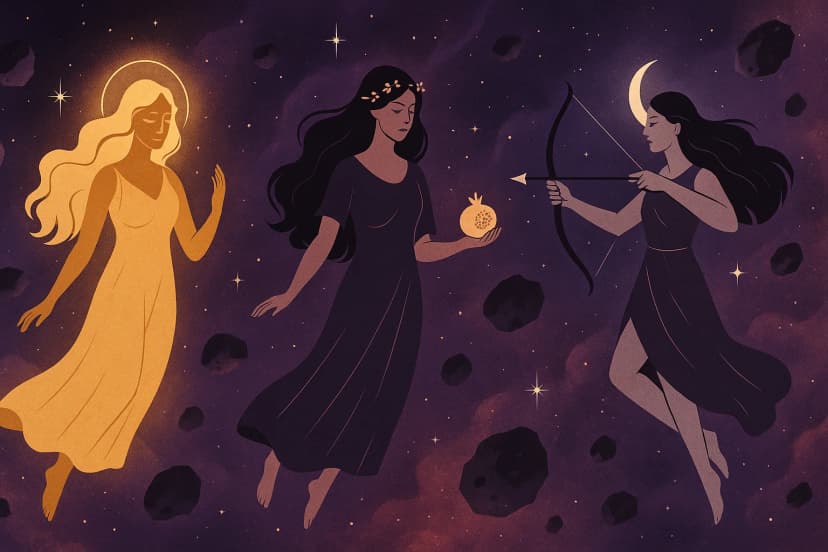
Aphrodite. Persephone. Artemis.
Three goddess asteroids that unlock deeper feminine archetypes. The sensual lover. The transformational queen. The wild huntress.
Most astrology apps ignore them. Yours doesn't have to.
TL;DR - What You Need to Know
Venus handles too much. One planet for:
- Romantic love
- Physical attraction
- Beauty and aesthetics
- Values and self-worth
- Pleasure and enjoyment
- Partnership style
That's like having one word for all emotions. The goddess asteroids add vocabulary.
| Asteroid | Number | Archetype | What It Reveals |
|---|---|---|---|
| Aphrodite | 1388 | Divine Lover | Magnetic attraction, sensuality, beauty power |
| Persephone | 399 | Queen of Underworld | Transformation, cycles, shadow integration |
| Artemis | 105 | Wild Huntress | Independence, sisterhood, protection |
| Asteroid | User Question It Answers |
|---|---|
| Aphrodite | "What makes me magnetic? How do I attract?" |
| Persephone | "How do I transform through dark times? What cycles repeat?" |
| Artemis | "Where am I fiercely independent? Who do I protect?" |
- For astrologers: Deeper feminine readings without generic Venus interpretations
- For app builders: Differentiate with goddess astrology (trending niche)
- For entrepreneurs: Women's wellness apps + astrology = growing market
- Swiss Ephemeris: API uses official IAU Minor Planet Center asteroid numbers (1388, 399, 105)
- Works with all chart types: Natal, transit, synastry, composite
Why Goddess Asteroids Matter
The four "main" asteroids (Ceres, Pallas, Juno, Vesta) have been used for decades. They're in most professional astrology software. Interestingly, all four were discovered at the beginning of the 19th century (1801-1807), synchronous with the rise of the women's movement in the West. As Demetra George notes in "Asteroid Goddesses," they symbolize four different facets of the feminine - Mother (Ceres), Daughter (Persephone), Wife (Juno), and Sister (Vesta) - going beyond the relatively simple categories traditionally represented by Venus and the Moon.
The Mythology Behind Each
Not the same as the planet Venus - this is a crucial distinction. According to asteroid astrologers, while Venus describes your values, love language, and aesthetic expression, asteroid Aphrodite shows how you magnetize, enchant, and experience the more archetypal threads of desire.
Venus is broader: relationships, finances, art appreciation, self-worth. Aphrodite is laser-focused on magnetic allure, sensual expression, and the transformative power of beauty. For the fullest picture of romantic and creative life, astrologers recommend reading three asteroids together: Aphrodite (#1388), Psyche (#16), and Eros (#433).
Queen of the Underworld. Daughter of Demeter who was abducted by Hades, then chose to stay part of each year. She represents:
- Transformation through darkness
- Cycles of descent and return
- Integration of shadow material
- The power gained through difficult initiations
- Autonomy and reclaiming personal will
Some astrologers consider Persephone "in domicile" in Libra, reasoning that Libra sits between Virgo (Ceres/Demeter) and Scorpio (Pluto/Hades) - making it the sign of the agreement between them, or the beloved object in the crossfire.
The huntress goddess. Twin sister of Apollo. She represents:
- Fierce independence
- Connection to wild nature
- Sisterhood and female bonds
- Protection of the vulnerable
- Choosing autonomy over partnership
Artemis has roots far older than Greek mythology. Both she and Diana were associated with the bear, and researchers believe these goddesses derive from ancient Neolithic bear cults. They're also linked to a Minoan goddess of mountains and hunting, and to the Great Mother Goddess archetype. When Artemis appears prominently alongside Black Moon Lilith, astrologers say they amplify the call to reclaim raw feminine power.
What These Asteroids Add to Venus
| Venus Alone | Venus + Goddess Asteroids |
|---|---|
| "You attract through charm" | "Your Aphrodite in Scorpio gives you magnetic, intense allure that transforms others" |
| "Relationship challenges" | "Your Persephone square Pluto suggests you transform through relationship underworlds" |
| "Independent streak" | "Your Artemis conjunct Moon: your emotional nature needs wild freedom" |
The API: Calculating Goddess Asteroids
The Astrology API now includes these three goddess asteroids alongside the standard four (Ceres, Pallas, Juno, Vesta).
Requesting Asteroid Positions
1const response = await fetch('https://api.astrology-api.io/v3/chart/natal', {2 method: 'POST',3 headers: {4 'X-Api-Key': 'your-api-key',5 'Content-Type': 'application/json'6 },7 body: JSON.stringify({8 birth_date: '1990-05-15',9 birth_time: '14:30',10 birth_location: 'New York, NY',11 active_points: [12 'Sun', 'Moon', 'Venus',13 'Aphrodite', 'Persephone', 'Artemis'14 ]15 })16});What You Get Back
1{2 "positions": {3 "Aphrodite": {4 "sign": "Scorpio",5 "degree": 15.42,6 "house": 8,7 "retrograde": false,8 "description": "Aphrodite (1388) - Divine feminine love, beauty, sensuality, magnetic attraction"9 },10 "Persephone": {11 "sign": "Cancer",12 "degree": 22.18,13 "house": 4,14 "retrograde": false,15 "description": "Persephone (399) - Transformation, cycles, descent/ascent, shadow integration"16 },17 "Artemis": {18 "sign": "Sagittarius",19 "degree": 8.91,20 "house": 9,21 "retrograde": false,22 "description": "Artemis (105) - Independence, wild nature, sisterhood, protection of the vulnerable"23 }24 }25}Asteroid Numbers Reference
The API uses standard Swiss Ephemeris asteroid numbers:
| Asteroid | Swiss Ephemeris Number | Formula |
|---|---|---|
| Aphrodite | 11388 | 10000 + 1388 |
| Persephone | 10399 | 10000 + 399 |
| Artemis | 10105 | 10000 + 105 |
These are the official Minor Planet Center designations.
Aphrodite (Asteroid 1388): Divine Magnetic Attraction
Aphrodite represents the power of beauty and attraction at its most divine. While Venus shows what we value and how we relate, Aphrodite shows specifically how we magnetize others.
Aphrodite Through the Signs
| Sign | Expression |
|---|---|
| Aries | Bold, direct attraction. Magnetic through confidence and initiative. |
| Taurus | Sensual, earthy allure. Beauty through physical presence and touch. |
| Gemini | Attractive through wit and words. Mental seduction, playful flirtation. |
| Cancer | Nurturing magnetism. Attracts through emotional depth and care. |
| Leo | Radiant, dramatic beauty. Attracts through performance and heart. |
| Virgo | Attractive through refinement. Subtle, discriminating allure. |
| Libra | Classic beauty and grace. Attracts through harmony and aesthetics. |
| Scorpio | Intense, transformative magnetism. Attracts through depth and mystery. |
| Sagittarius | Exotic, adventurous allure. Attracts through vision and enthusiasm. |
| Capricorn | Sophisticated, authoritative beauty. Attracts through achievement. |
| Aquarius | Unique, unconventional attraction. Attracts through originality. |
| Pisces | Ethereal, mystical allure. Attracts through sensitivity and imagination. |
Aphrodite in Houses
| House | Where Magnetism Manifests |
|---|---|
| 1st | Personal presence is magnetic. Beauty is part of identity. |
| 2nd | Attracts through resources, voice, or physical beauty. |
| 3rd | Attracts through communication and local connections. |
| 4th | Magnetic in private life. Beauty expressed at home. |
| 5th | Creative and romantic magnetism. Attracts lovers and admirers. |
| 6th | Attracts through service and work. Beauty in daily routines. |
| 7th | Attracts partners easily. Magnetism expressed through relationships. |
| 8th | Deep, transformative attraction. Magnetic in intimate settings. |
| 9th | Attracts through wisdom and travel. Foreign allure. |
| 10th | Public magnetism. Career involves beauty or attraction. |
| 11th | Attracts friends and groups. Magnetic in social causes. |
| 12th | Hidden magnetism. Unconscious allure. Spiritual beauty. |
Aphrodite Aspects
Persephone (Asteroid 399): Transformation Through Darkness
Persephone is the asteroid of cycles, transformation, and shadow integration. She rules the underworld journey.
The Persephone Archetype
Persephone starts as innocent Kore, the maiden. She descends to the underworld (by force or choice, depending on the telling). She becomes Queen. She returns changed.
In a chart, Persephone shows:
- Where we undergo initiatory experiences
- How we transform through difficulty
- Our relationship with power and the unconscious
- Cycles of loss and renewal
Persephone Through the Signs
| Sign | Transformation Style |
|---|---|
| Aries | Transforms through crisis of identity. Underworld journey initiates new self. |
| Taurus | Transforms through loss of security. Learns to find stability within. |
| Gemini | Transforms through mental crisis. Underworld journey involves ideas and communication. |
| Cancer | Transforms through family or emotional upheaval. Deep roots reshaped. |
| Leo | Transforms through ego death. Creative self emerges from darkness. |
| Virgo | Transforms through crisis of service or health. Perfection shattered and rebuilt. |
| Libra | Transforms through relationship crisis. Partnership as underworld journey. |
| Scorpio | Double underworld energy. Profound, repeated transformations. Phoenix nature. |
| Sagittarius | Transforms through crisis of meaning. Beliefs shattered and rebuilt. |
| Capricorn | Transforms through career or authority crisis. Rebuilds structures from within. |
| Aquarius | Transforms through social crisis. Revolutionary awakening through darkness. |
| Pisces | Transforms through spiritual crisis. Dissolution leads to transcendence. |
Persephone in Houses
| House | Where Transformation Occurs |
|---|---|
| 1st | Identity itself transforms repeatedly. Visible phoenix nature. |
| 2nd | Transforms through financial or value crises. |
| 3rd | Transforms through communication breakdowns or sibling dynamics. |
| 4th | Transforms through family patterns. Ancestral underworld work. |
| 5th | Transforms through creative blocks or romantic crises. |
| 6th | Transforms through health crises or work upheaval. |
| 7th | Transforms through partnership dynamics. Others trigger descents. |
| 8th | Double underworld emphasis. Shared resources, sexuality, death/rebirth. |
| 9th | Transforms through crisis of belief. Educational or travel initiations. |
| 10th | Transforms through career upheaval. Public role involves rebirth. |
| 11th | Transforms through group dynamics or failed hopes. |
| 12th | Transforms through spiritual crisis. Unconscious underworld work. |
Persephone Aspects
Artemis (Asteroid 105): Wild Independence
Artemis is the goddess who chose freedom. She asked Zeus to grant her eternal virginity (meaning autonomy, not abstinence) and the company of nymphs (sisterhood) over marriage.
The Artemis Archetype
Artemis in a chart shows:
- Where we fiercely protect our independence
- Our relationship with wild nature
- How we bond with other women (or feminine energy)
- What we protect and nurture in its wild state
- Our capacity for focused pursuit (hunting)
Artemis Through the Signs
| Sign | Independence Expression |
|---|---|
| Aries | Fiercely self-directed. Pioneer independence. Protector of new beginnings. |
| Taurus | Independent through self-sufficiency. Protects natural resources. |
| Gemini | Mental independence. Protects freedom of thought and communication. |
| Cancer | Independent through emotional boundaries. Protects family and home. |
| Leo | Independent creative expression. Protects the inner child and joy. |
| Virgo | Independent through skills and service. Protects health and nature. |
| Libra | Paradox: independent in relationships. Protects fairness and beauty. |
| Scorpio | Fiercely independent emotionally. Protects through transformation. |
| Sagittarius | Freedom through philosophy and travel. Protects truth and vision. |
| Capricorn | Independent through achievement. Protects traditions and structures. |
| Aquarius | Independent through uniqueness. Protects outcasts and revolutionaries. |
| Pisces | Independent through spirituality. Protects the vulnerable and dreamers. |
Artemis in Houses
| House | Where Independence Manifests |
|---|---|
| 1st | Identity defined by independence. Visible warrior nature. |
| 2nd | Financially independent. Self-sustaining. |
| 3rd | Independent thinker. Protects siblings or local community. |
| 4th | Independent from family patterns. Creates own sanctuary. |
| 5th | Creative independence. Protects children or creative projects. |
| 6th | Independent in work. Protects animals or health practices. |
| 7th | Independent within partnerships. Needs freedom in relationships. |
| 8th | Independent in intimate matters. Transforms through autonomy. |
| 9th | Independent seeker. Protects beliefs and educational freedom. |
| 10th | Career involves independence. Public image as autonomous. |
| 11th | Independent within groups. Protects friends and causes. |
| 12th | Spiritual independence. Protects the unseen and unconscious. |
Artemis Aspects
Building Goddess Asteroid Features
Here's how to implement these asteroids in your app.
Example 1: Goddess Archetype Profile
1async function getGoddessProfile(userId) {2  const user = await getUser(userId);3
4  const chart = await fetch('/api/chart/natal', {5    method: 'POST',6    body: JSON.stringify({7      birth_date: user.birth_date,8      birth_time: user.birth_time,9      birth_location: user.birth_location,10      active_points: ['Aphrodite', 'Persephone', 'Artemis', 'Venus', 'Moon']11    })12  }).then(r => r.json());13
14  return {15    magnetic_power: {16      sign: chart.positions.Aphrodite.sign,17      house: chart.positions.Aphrodite.house,18      description: getAphroditeInterpretation(chart.positions.Aphrodite)19    },20    transformation_style: {21      sign: chart.positions.Persephone.sign,22      house: chart.positions.Persephone.house,23      description: getPersephoneInterpretation(chart.positions.Persephone)24    },25    independence_expression: {26      sign: chart.positions.Artemis.sign,27      house: chart.positions.Artemis.house,28      description: getArtemisInterpretation(chart.positions.Artemis)29    }30  };31}
Example 2: Goddess Transit Alerts
1async function checkGoddessTransits(userId) {2  const user = await getUser(userId);3
4  const transits = await fetch('/api/transits', {5    method: 'POST',6    body: JSON.stringify({7      birth_data: user.birth_data,8      transit_date: new Date().toISOString(),9      active_points: ['Aphrodite', 'Persephone', 'Artemis']10    })11  }).then(r => r.json());12
13  const alerts = [];14
15  // Check for significant transits16  transits.aspects.forEach(aspect => {17    if (aspect.transiting_planet === 'Aphrodite' && aspect.aspect === 'conjunction') {18      alerts.push({19        type: 'aphrodite_activation',20        message: `Your ${aspect.natal_planet} is being activated by transit Aphrodite. Magnetic energy heightened.`21      });22    }23
24    if (aspect.transiting_planet === 'Persephone' && ['conjunction', 'square', 'opposition'].includes(aspect.aspect)) {25      alerts.push({26        type: 'persephone_activation',27        message: `Transformative transit: Persephone ${aspect.aspect} your ${aspect.natal_planet}. Underworld work activated.`28      });29    }30
31    if (aspect.transiting_planet === 'Artemis' && aspect.aspect === 'conjunction') {32      alerts.push({33        type: 'artemis_activation',34        message: `Your ${aspect.natal_planet} seeks freedom. Artemis conjunction activates independence.`35      });36    }37  });38
39  return alerts;40}
Example 3: Synastry Goddess Comparison
1async function compareGoddessEnergy(person1, person2) {2  const synastry = await fetch('/api/synastry', {3    method: 'POST',4    body: JSON.stringify({5      person1: person1.birth_data,6      person2: person2.birth_data,7      active_points: ['Aphrodite', 'Persephone', 'Artemis', 'Venus', 'Mars']8    })9  }).then(r => r.json());10
11  // Find goddess aspects between charts12  const goddessAspects = synastry.aspects.filter(a =>13    ['Aphrodite', 'Persephone', 'Artemis'].includes(a.planet1) ||14    ['Aphrodite', 'Persephone', 'Artemis'].includes(a.planet2)15  );16
17  return {18    magnetic_chemistry: goddessAspects.filter(a =>19      a.planet1 === 'Aphrodite' || a.planet2 === 'Aphrodite'20    ),21    transformation_potential: goddessAspects.filter(a =>22      a.planet1 === 'Persephone' || a.planet2 === 'Persephone'23    ),24    independence_dynamics: goddessAspects.filter(a =>25      a.planet1 === 'Artemis' || a.planet2 === 'Artemis'26    )27  };28}
Real Use Cases
For Feminine Wellness Apps
Growing market: women's wellness apps incorporating astrology.
- Create "Goddess Archetype" profiles
- Track feminine energy through transits
- Offer cycle-synced content based on Persephone position
- Provide independence coaching based on Artemis
For Dating Apps
Beyond standard synastry.
- Show "Magnetic Chemistry" between users (Aphrodite aspects)
- Identify transformation potential (Persephone compatibility)
- Flag independence dynamics (Artemis aspects)
For Astrologer Tools
Deepen feminine chart analysis.
- Offer specialized goddess readings
- Create archetype reports
- Analyze feminine development through progressions
- Track goddess asteroid transits
For Content Platforms
Goddess archetype content performs well.
- Generate personalized goddess horoscopes
- Create archetype quiz features
- Produce individualized content based on dominant goddess
FAQ
Are these "real" asteroids?
Yes. They're catalogued by the Minor Planet Center with official designations:
- 1388 Aphrodite (discovered 1935)
- 399 Persephone (discovered 1895)
- 105 Artemis (discovered 1868)
How do goddess asteroids differ from the planet Venus?
Venus represents the general principle of attraction, values, and relationship style. The goddess asteroids represent specific archetypes within feminine experience. Aphrodite is focused magnetic power. Persephone is transformative descent. Artemis is fierce independence.
Should I use these for all charts or just women's charts?
Everyone has these asteroids in their chart. Men also have Aphrodite (their magnetic power), Persephone (how they transform), and Artemis (their independence). However, these asteroids are particularly popular in feminine-focused astrology.
What orbs should I use for asteroid aspects?
Tighter orbs than planets. Generally 2-3 degrees for major aspects (conjunction, opposition, square, trine) and 1-2 degrees for minor aspects (sextile).
Can I use these for horoscopes?
Yes. Transit Aphrodite, Persephone, and Artemis can trigger natal planets just like any other body. Their faster movement (compared to outer planets) creates more frequent activations.
Where can I learn more about asteroid interpretation?
Demetra George's "Asteroid Goddesses" is the foundational text. Martha Lang-Wescott has extensive asteroid research. The API provides basic interpretations, but deeper work benefits from specialized study.
A Critical View: The Problems Nobody Talks About
We've just given you three new asteroids to add to your app. Now let's be honest about some uncomfortable truths.
The Gender Marketing Problem
"Goddess asteroids." "Feminine astrology." "Women's charts."
Notice the branding? These asteroids are sold as women's astrology. Wellness apps market them to female users. Instagram astrologers frame them as tools for "feminine awakening."
Mythological archetypes don't "belong" to any gender. Artemis was a goddess, but independence isn't exclusively feminine. Aphrodite was female, but magnetic attraction isn't women-only. The gendering is a marketing choice, not an astrological necessity.
When you build "goddess asteroid" features, you're participating in a framing that:
- Limits who feels invited to explore these archetypes
- Reinforces gender essentialism in astrology
- Reduces market reach (why exclude half your potential users?)
Consider: what if you framed them as "archetypal asteroids" instead?
The Infinite Invention Problem
Aphrodite. Persephone. Artemis. Also: Narcissus. Kafka. Bacchus. There's an asteroid called "Garage." There's one called "Bacon."
This is a methodological problem. When you have infinite variables, you can always find something that "explains" anything. Post-hoc pattern matching isn't astrology - it's confirmation bias with extra steps.
The "Big 4" asteroids (Ceres, Pallas, Juno, Vesta) at least have historical precedent. They've been used since the 1970s. There's a body of interpretive work.
These three goddess asteroids? They're popular because the myths are compelling, not because the interpretations have been validated by decades of practice.
We're not saying don't use them. We're saying: know what you're building on.
The Archetype Trap
"Your Artemis is strong" - so you're the independent one, forever. "Your Aphrodite dominates" - you're the magnetic beauty, that's your role. "Persephone in the 7th" - you're destined for transformative relationships, probably difficult ones.
People are more complicated than archetypes. Someone can be fiercely independent AND deeply partnered. Magnetically attractive AND intellectually serious. The problem with archetype-based readings is they can become prescriptive rather than descriptive.
The goddess asteroid framework can encourage people to identify with narrow mythic roles rather than develop their full complexity. "I'm such an Artemis" might feel empowering - but it might also be a way of avoiding the Aphrodite vulnerability that's harder to claim.
When you build these features, consider: are you helping users understand themselves, or giving them pretty boxes to climb into?
The Persephone Problem
Here's the myth: Persephone was picking flowers. Hades abducted her. He took her to the underworld. She ate pomegranate seeds (some versions say she was tricked, others that she chose). She became Queen of the Underworld.
Modern astrology reframes this as: "transformation," "descent and return," "shadow integration," "empowerment."
Yes, Persephone becomes Queen. Yes, she gains power. But the original myth is about loss of consent, forced separation from her mother, and adapting to captivity.
"Reframing" this as empowerment - without acknowledging the violence - is a choice. It's sanitizing a myth about abduction into a self-help narrative.
When you offer Persephone interpretations to users, consider:
- Is there a way to honor the transformation narrative without erasing the coercion?
- Are you accidentally telling someone their difficult experience was "meant to make them stronger"?
- What responsibility do you have when myth-based interpretations might minimize real experiences of violence or loss of agency?
We're not saying don't use Persephone. The archetype resonates for real reasons - many people DO transform through experiences they didn't choose. But the framing matters.
So Why Are We Offering These Asteroids?
Because users want them. Because the myths ARE compelling. Because, for all these critiques, there's something genuinely useful in having more vocabulary for experience.
The API calculates positions. What you do with those positions - how you frame them, who you market them to, what stories you tell - that's your choice.
Just make it an informed one.
Conclusion
Venus does a lot. Too much.
The goddess asteroids give your app vocabulary for feminine experience that Venus alone can't provide.
Most astrology apps stop at Venus. Yours can go deeper.
The API now calculates all three goddess asteroids (1388, 399, 105) alongside standard points. Same request format, same response structure, deeper insights.
Your users want to understand their feminine power. Now you can show them.